Tamatebako: Urashima Taro's box of time
Learn what the tamatebako is and how the mysterious box from Ryugu-jo symbolizes time, promise, and loss in Japanese folklore.
What is the tamatebako?
The tamatebako is the mysterious box Otohime gives to Urashima Taro when he leaves Ryugu-jo, the Dragon Palace beneath the sea. In the best-known modern version, it comes with one condition: Urashima must never open it.
At first the box looks like a farewell gift, but its narrative role is deeper. When Urashima returns to the shore and realizes that the world he knew has vanished into time, he opens it. White smoke escapes, and the young fisherman suddenly becomes old.
That is why the tamatebako is more than a magical object. It is the tale’s most concentrated image: a small box holding the distance between worlds, the weight of lost time, and the impossibility of returning to the exact place where life began.
The meaning of the name tamatebako
In Japanese, tamatebako is written 玉手箱. The word gathers images of value, care, and containment: 玉 can suggest a jewel or something precious; 手 is connected with the hand; 箱 means box. A loose rendering might be “precious box,” “jewel box,” or “ornamented hand box.”
But in Urashima Taro, the value of the tamatebako is not gold, gems, or treasure. Its value lies in what cannot be recovered: the time that has slipped beyond Urashima’s reach.
This brings the tamatebako close to older keepsake objects in the Urashima tradition. In some medieval forms of the tale, the box appears as a memento from the otherworldly woman. The wording changes, but the function remains: the object preserves a dangerous bond with what has been lost.
What was inside the tamatebako?
The familiar explanation is that Urashima Taro’s old age was inside the tamatebako. While he remained in Ryugu-jo, his body seemed protected from ordinary aging; outside the palace, however, human time continued to move.
When the box opens, that separation disappears. The white smoke makes visible something that had been invisible until then: accumulated years, distance, memory, loss, and mortality.
Some variants give the box layers or different contents, including smoke, a mirror, and feathers. These details change from version to version, but they point to the same symbolic center: Urashima tries to touch a memory of the other world and instead meets the truth of time.
Why does Otohime give him the box?
A simple reading says that the tamatebako is punishment for Urashima’s disobedience. He receives a clear command, opens the box anyway, and suffers the consequence. That reading exists, but it does not exhaust the tale.
Otohime does not hand him a weapon. She gives him a closed box and a warning. This suggests that the tamatebako works as a boundary: while it remains closed, it preserves a fragile bond between Urashima and Ryugu-jo; when it opens, that bond breaks.
Seen this way, the box is gift, warning, and pact at once. It lets Urashima leave the palace carrying something from the other world, but it also makes clear that wonder has rules. Whoever crosses the border between worlds does not return unchanged.
The box and otherworldly time
Many Japanese tales imagine places where time works differently: mountains, distant islands, undersea palaces, and lands of immortals. Ryugu-jo belongs to this kind of space. A few days there can equal decades or centuries in the human world.
The tamatebako is the object Urashima brings back from that impossible place. Closed, it keeps alive the fantasy that he can still exist between two realities. Opened, it forces human time to catch up with him.
That is the object’s poetic force. The box does not create Urashima’s tragedy; it reveals a tragedy that has been waiting for him since the moment he crossed the border of the sea.
Tamatebako and other forbidden boxes
The tamatebako is often compared with other forbidden containers in myth and folklore, especially Pandora’s box. The comparison is useful, but the difference matters: Pandora releases evils into the world; the tamatebako changes Urashima.
The tragedy here is intimate. The box does not scatter disaster across humanity. It returns to one man the years his adventure had suspended. That makes its tone less catastrophic and more melancholy.
It is not merely a trap for curiosity. It is a box about longing, limits, and impermanence. Urashima opens it because he has lost the home he knew; what he finds is not a way back, but proof that the past was not preserved intact.
The meaning of the tamatebako
The tamatebako is one of the keys to understanding Urashima Taro. Without it, the tale would mainly be about a fisherman who visits an enchanted palace. With it, the story becomes a meditation on time, promise, memory, and impossible return.
The box connects Otohime, Ryugu-jo, the turtle, and the tale’s moral center. It comes from the undersea world, reaches Urashima as a gift, and finally reveals the emotional cost of having lived outside ordinary time.
At heart, the tamatebako speaks to a simple and painful human experience: we carry precious memories, but we cannot open the past and step back inside it. When we try, we meet the distance between what we lived and who we still are.
Index of Japanese terms
Tamatebako
The mysterious box given to Urashima Taro. In the tale, it concentrates the difference between the time he experienced in Ryugu-jo and the time that kept passing in the human world.
Tamakushige
An older expression associated with a precious casket or keepsake box. Some traditions and studies connect this image with earlier forms of the object later known as the tamatebako.
Otohime
The princess of the undersea palace. She welcomes Urashima Taro to Ryugu-jo and, in the best-known version, gives him the box when he leaves.
Ryugu-jo
The Dragon Palace, a wondrous undersea realm where time does not follow the same measure as the human world.
Ura no Shimako
A name associated with older Urashima traditions found in classical Japanese records before the modern children’s tale took shape.
You might also like
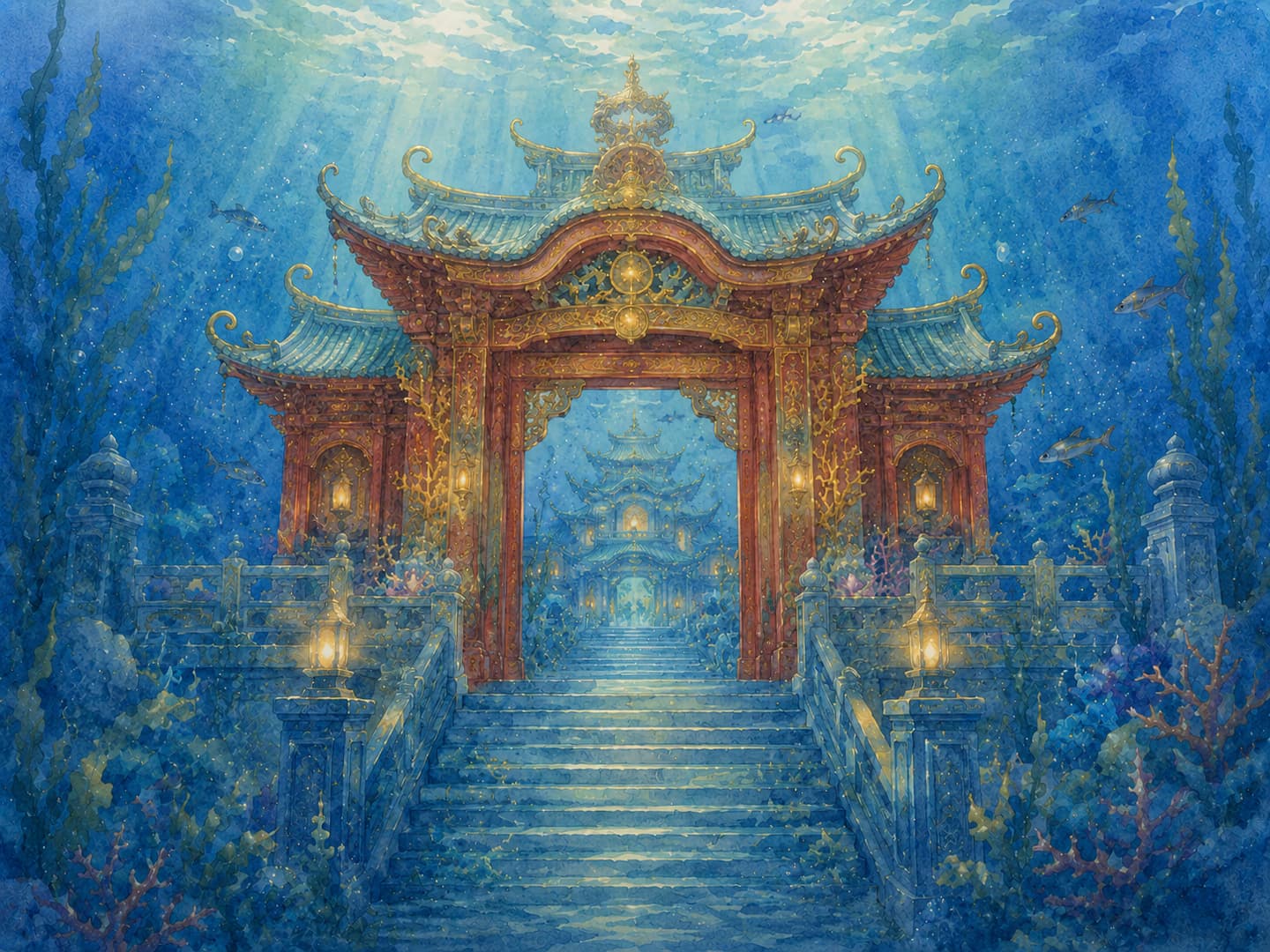
The Dragon Palace is not only an undersea wonder: it is the border where beauty, hospitality, and another measure of time…
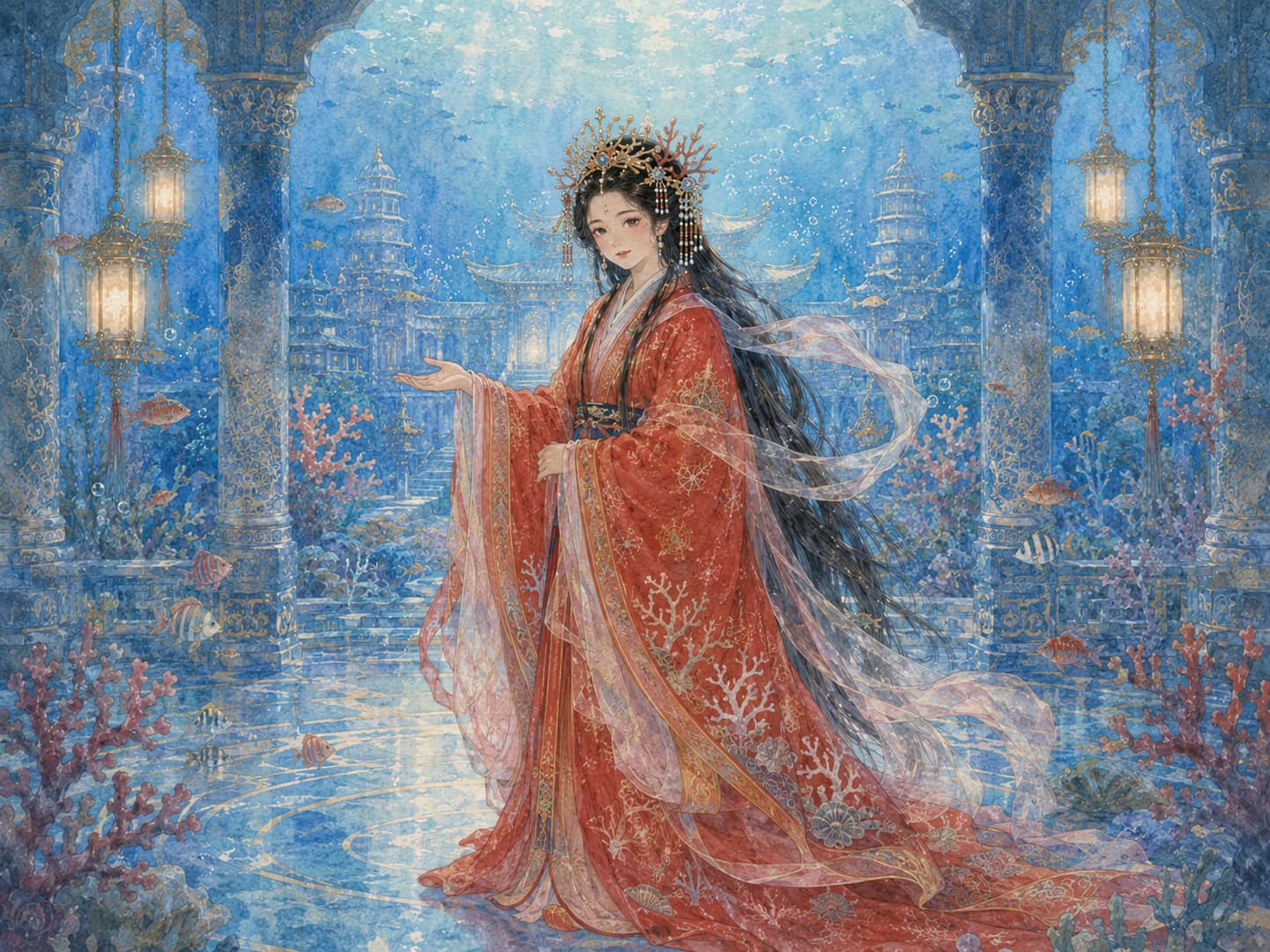
The sea princess gives Ryugu-jo a human face: graceful, mysterious, generous, and bound to rules the visitor cannot fully…
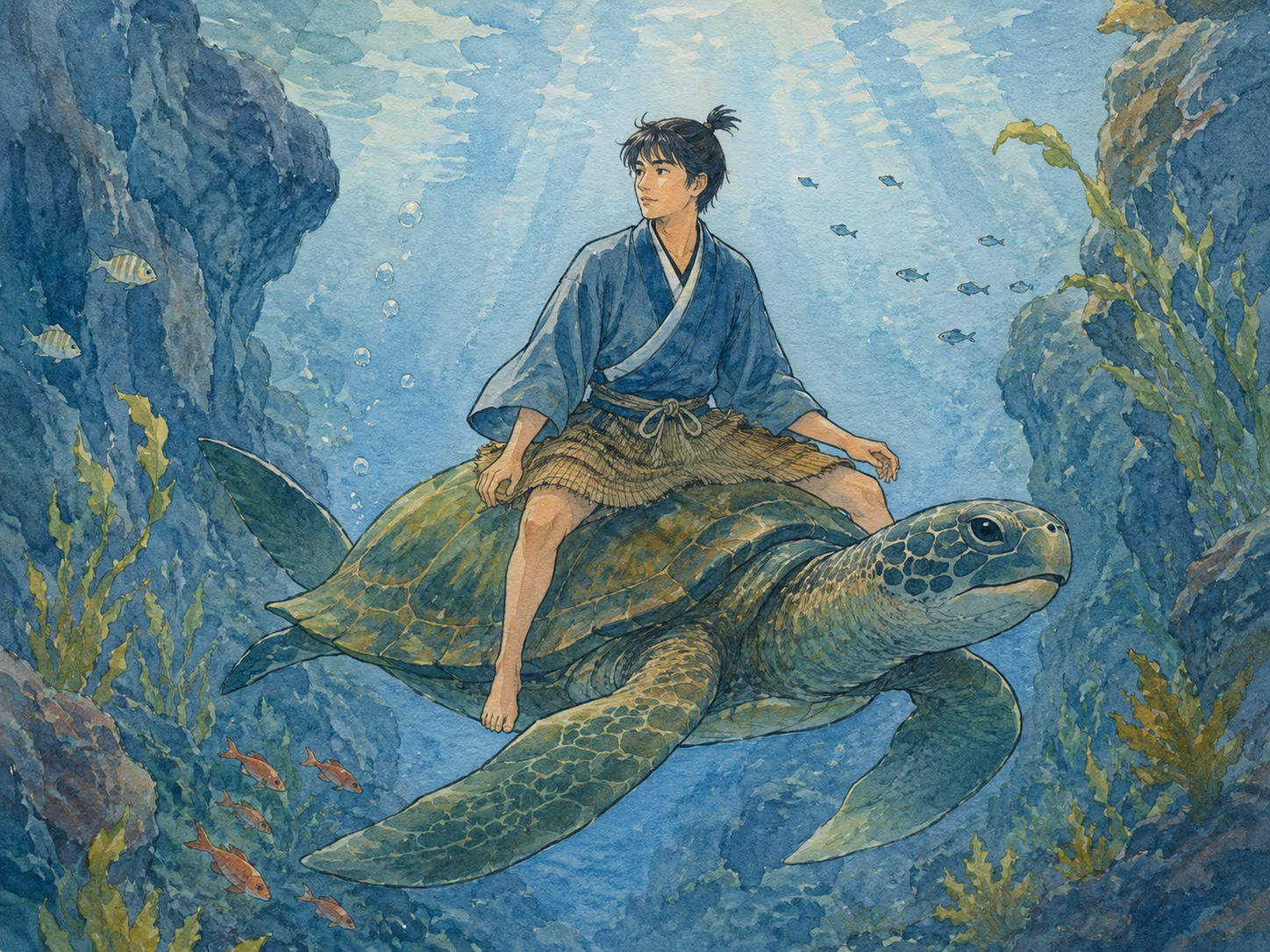
Read Urashima Taro, the Japanese legend of a fisherman who saves a turtle, visits Ryugu-jo, and returns with the mysterious…