Taketori no Okina: the Bamboo Cutter who found Kaguya-hime
Meet Taketori no Okina, the old bamboo cutter who finds Kaguya-hime: his name, craft, adoptive fatherhood, wealth, and place between worlds.
Who is Taketori no Okina?
Taketori no Okina is the old bamboo cutter who finds Kaguya-hime in Taketori Monogatari. Before there is a Moon Princess, suitors, court society, and farewell, there is an ordinary man going into fields and mountains to work.
That order matters. The work begins with the cutter because wonder enters the human world through him. Kaguya appears inside a glowing bamboo stalk, but the first person to see that light is someone used to seeing bamboo as material for survival.
So Taketori no Okina is not merely “the old man who found Kaguya.” He is the narrative, material, and emotional doorway of the story: the worker who turns discovery into care.
The meaning of Taketori no Okina
Taketori no Okina appears in Japanese as 竹取翁. The first character, 竹 (take), means bamboo; 取 (tori) suggests taking, gathering, or cutting; and 翁 (okina) means an old man or elder. The name describes a craft before it describes noble lineage.
This creates a powerful contrast with the rest of the work. The girl he finds will be pursued by nobles and even by the emperor, but her first relationship with the human world begins outside the palace, in the space of manual labor.
The text also records the personal name 讃岐造 (Sanuki no Miyatsuko). That detail is small but precious: the character is not reduced to an anonymous role. He has a name, a routine, a house, and a concrete human position before the impossible.
Bamboo as work and passage
In the article about Kaguya-hime, bamboo appears as an image of light and birth. Here, it also needs to be seen as raw material. The cutter lives from bamboo: he enters the vegetation, cuts the stalks, and turns the plant into useful objects.
That material dimension changes the scene of discovery. The miracle does not appear during a ceremony, a pilgrimage, or a dream. It appears in the middle of a repeated, humble, everyday activity.
Bamboo becomes a passage because the cutter already knows it with his hands. The supernatural does not break into the world from outside; it opens from inside a material the old man touched every day.
Kaguya-hime’s adoptive father
When he finds the tiny girl, the cutter brings her home and entrusts her to his wife’s care. That gesture establishes the family dimension of the story: Kaguya is not only discovered, she is welcomed.
Taketori no Okina’s fatherhood is shaped by tenderness and limit. He raises Kaguya as a daughter, wants to protect her, and rejoices in her presence, yet he can never fully govern her origin or destiny.
That limit makes him human. He loves as a father, but his authority does not reach the Moon. Part of the tale’s pain comes from the difference between caring for someone and being able to decide for them.
Wealth, gold, and the changed household
After Kaguya’s arrival, the cutter finds gold inside other bamboo stalks and his household changes. A simple worker gains wealth, prestige, and a new social position.
But this ascent does not dissolve the story’s tension. Wealth brings the house closer to the court, attracts attention, and prepares the scene for the suitors, but it does not solve Kaguya’s mystery.
The detail matters: the same bamboo that brings the child also brings gold. The work connects affection, fortune, and wonder, but it does not allow any of them to purchase the princess’s permanence.
The cutter’s house as a boundary
Taketori no Okina’s house becomes a meeting place for social and cosmic layers. On one side are the simple household, the wife, the baskets, and bamboo objects. On the other come nobles, messengers, marriage expectations, and signs of the lunar world.
This house is a boundary. It receives Kaguya as a child, later presents her to the courtly world, and finally has to recognize that it cannot prevent her return.
The cutter always stands in that middle space: between field and house, house and court, affection and authority, Earth and Moon. His role is less to solve conflict than to reveal where human limits begin.
Why can the work be remembered through the cutter?
Today many people call the story Princess Kaguya, and that makes sense: Kaguya is the tale’s most memorable image. Even so, tradition preserves titles tied to the old man, such as Taketori Monogatari and Taketori no Okina Monogatari.
That choice shows that the work is not only about the princess. It is also about encounter: someone from ordinary life finds something that does not belong to ordinary life and must give that miracle a human form.
The old bamboo cutter gives the text its first perspective. The story begins where he works, passes through his house, and transforms his family before reaching the court and the Moon.
The humanity of the old bamboo cutter
Taketori no Okina is not a warrior hero or a flawless sage. He is excited by wealth, wants to protect Kaguya, participates in human negotiations, and suffers when he realizes that his wishes are not enough.
That imperfection is part of his beauty. He represents the human being before wonder: enchanted, grateful, sometimes confused, but deeply attached to what he has received.
The tale would be colder without him. Kaguya might be only a distant figure from the Moon; with the cutter and his wife, she also passes through the experience of everyday care, household life, and adoptive love.
Why does Taketori no Okina still matter?
Taketori no Okina still matters because he reminds us that great stories do not always begin with kings, warriors, or gods. Sometimes they begin with someone working, looking carefully at what seemed ordinary every day.
He shows that wonder needs a human doorway. The bamboo shines, Kaguya appears, the Moon calls; but the old cutter is the one who brings the child home and allows the impossible to be loved for a while.
Index of Japanese terms
Taketori no Okina
An expression meaning “the old bamboo cutter.” It is the form by which the character enters the memory of the work.
Sanuki no Miyatsuko
The personal name given to the old man in the classical text. It reminds us that he is not only a narrative function: he also has identity within the textual tradition.
Take
Bamboo. Here it is material labor, source of wealth, site of revelation, and boundary between ordinary life and wonder.
Okina
Old man or elder. In older narratives, it can suggest age, social simplicity, and practical wisdom.
Uba
The old cutter’s wife. She shares in the domestic care of Kaguya and completes the adoptive dimension of the human household.
Kago
Basket. In the classical opening, the child is raised in a basket tied to the cutter’s craft, a detail that brings miracle and manual labor close together.
Read also
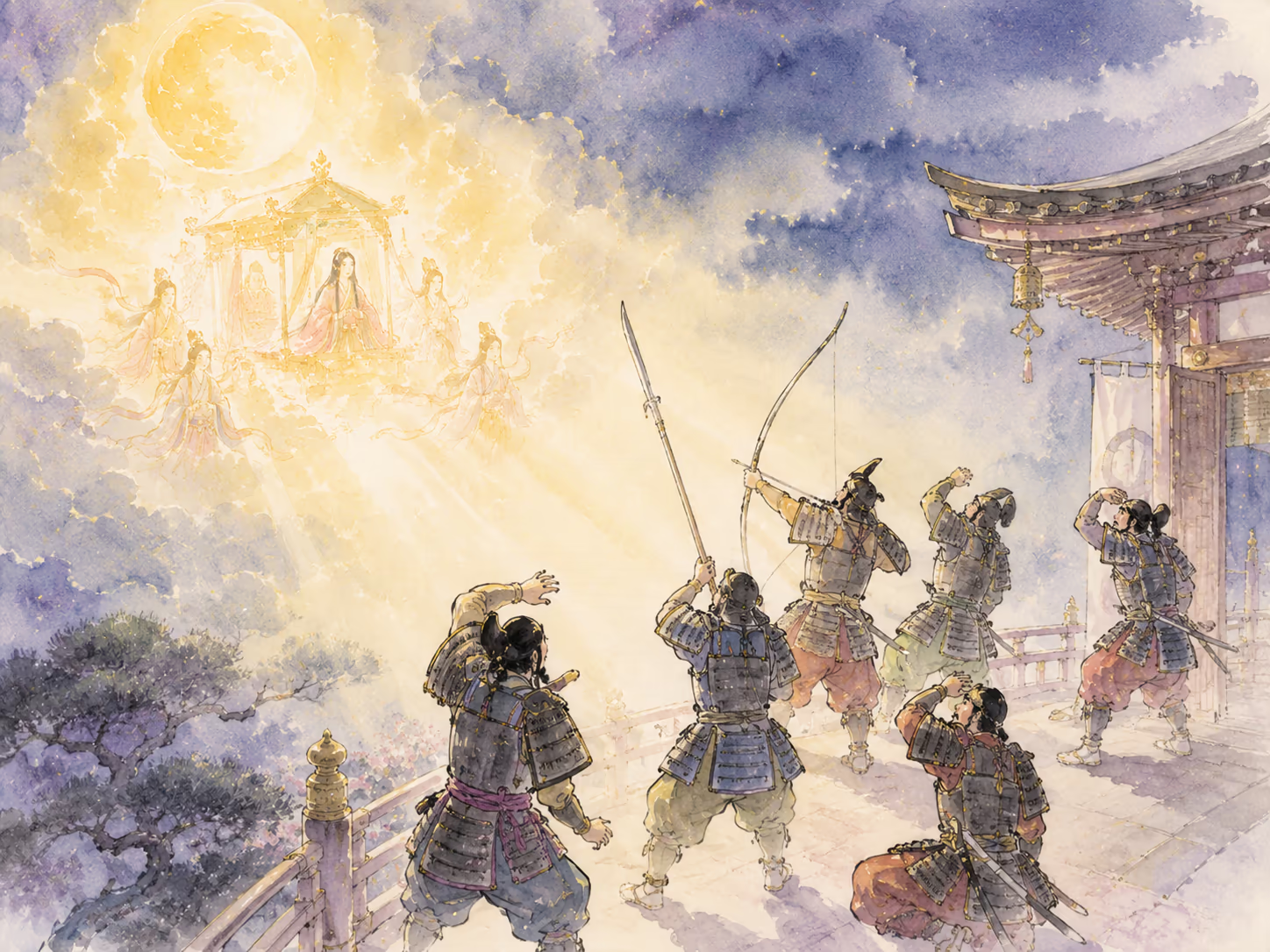
Guide to Princess Kaguya: the bamboo cutter, the Moon Princess, impossible tasks, the lunar procession, and the ache of…
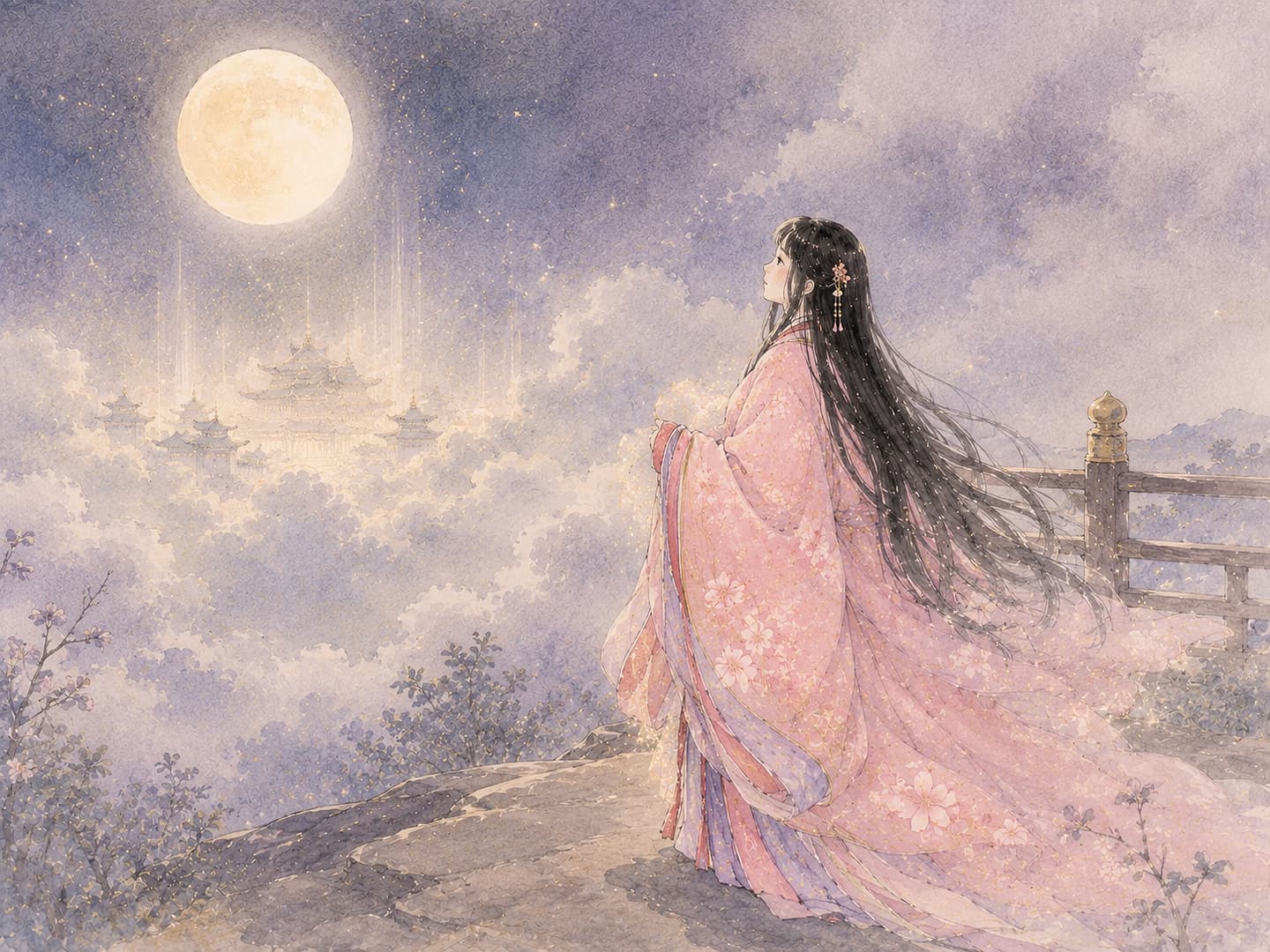
The cultural figure of Princess Kaguya: name, radiance, Moon, otherness, autonomy, and her lasting place in Japanese…
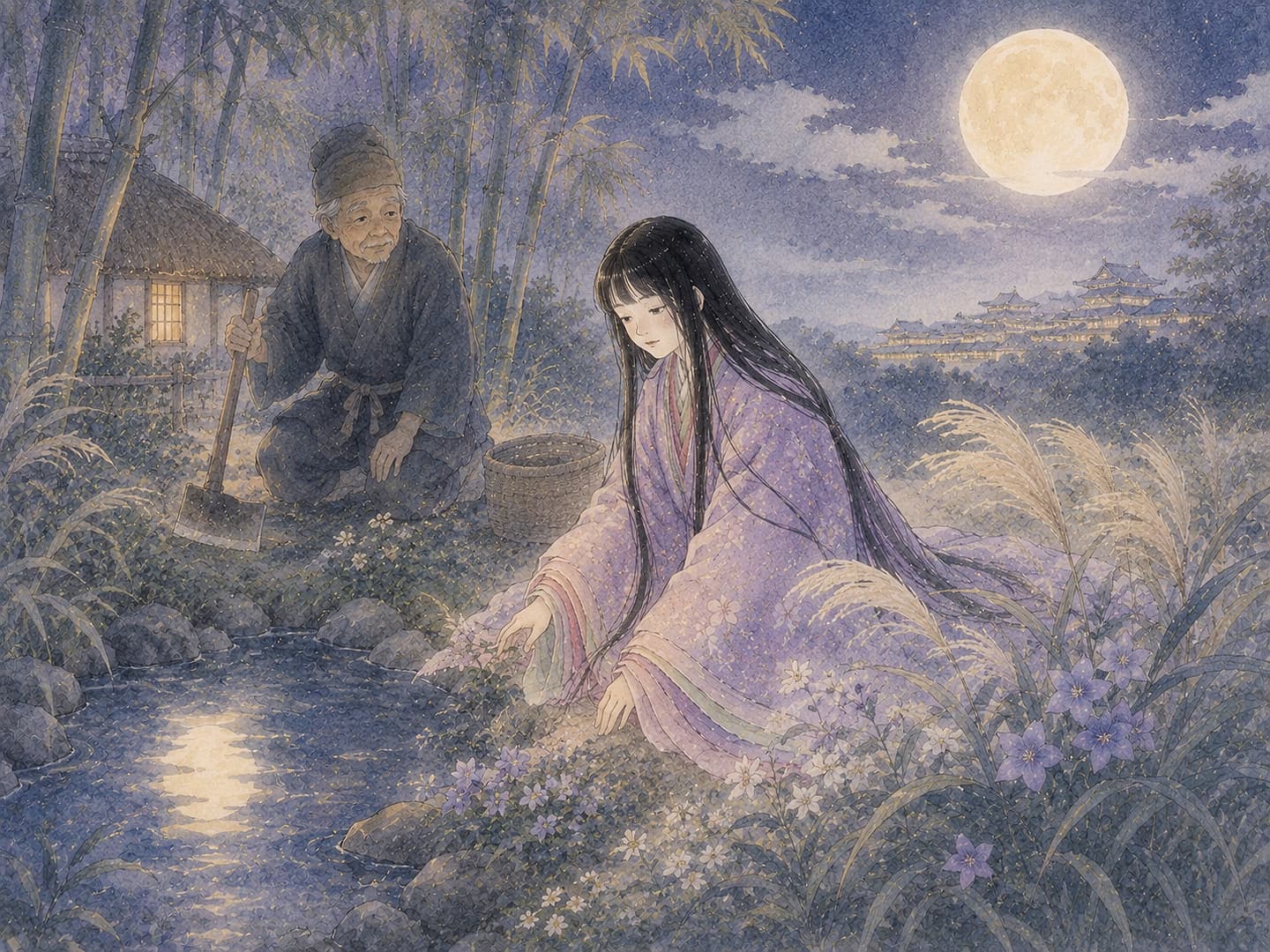
The classical work behind Princess Kaguya: monogatari, Heian court culture, humor, the Moon, and Kaguya-hime as literature.
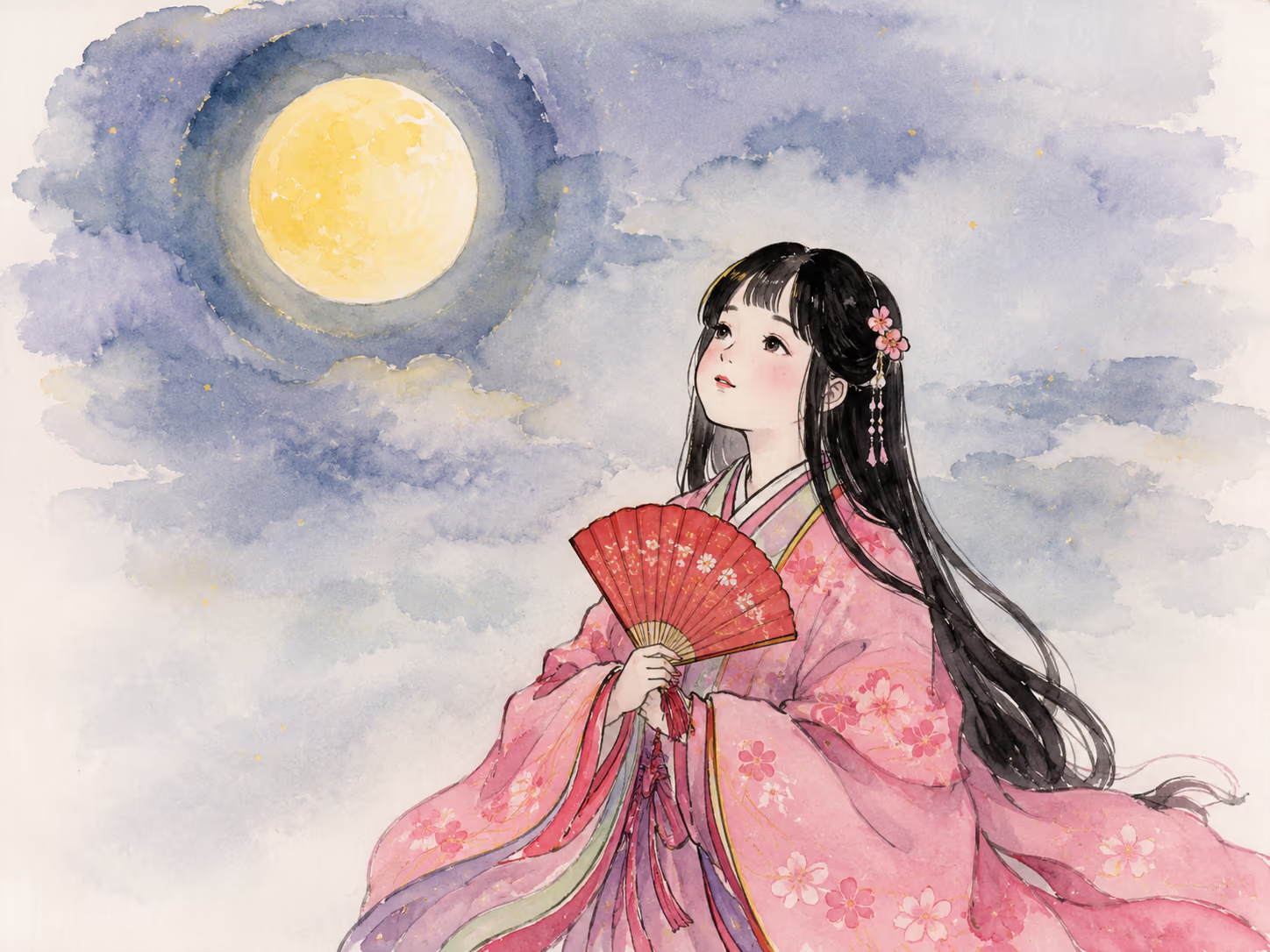
The Japanese tale of Kaguya-hime, the Moon Princess found inside bamboo and raised between affection, mystery, and fate.