Kaguya-hime: the Moon Princess in Japanese folklore
Meet Kaguya-hime, the luminous princess of Taketori Monogatari: the meaning of her name, her link to the Moon, her symbolism, and her place in Japanese culture.
Who is Kaguya-hime?
Kaguya-hime is the luminous princess of Taketori Monogatari, The Tale of the Bamboo Cutter. She enters Japanese literature as a double presence: a girl found on Earth and a visitor from a world Earth cannot fully understand.
That is why this article treats Kaguya as more than the protagonist of a plot summary. She is a cultural figure: a name, an image, a lunar symbol, a literary character, and a meeting point between folklore, Heian court culture, popular memory, and modern imagination.
Kaguya’s power lies in that distance. She joins human life, is raised by a family, receives names, clothing, and suitors, yet never fits entirely inside the system that tries to define her.
The meaning of the name Kaguya-hime
The Japanese name かぐや姫 (Kaguya-hime) is usually understood as “luminous princess” or “princess who shines.” The character 姫 (hime) points to a princess or noble young woman, while Kaguya draws the character toward brightness, glow, and radiant beauty.
That reading matches her first appearance: she is found inside a bamboo stalk that gives off light. Before the Moon explains her, Kaguya is already perceived as brightness inside ordinary life, a presence that changes the bamboo cutter’s familiar world.
The form なよ竹のかぐや姫 (nayotake no Kaguya-hime) adds another layer. The term なよ竹 suggests young, flexible bamboo. The character is therefore not only lunar: she also belongs to the vegetal image of bamboo, to the grace of something that bends without losing mystery.
Literary character and folklore figure
It helps to distinguish Kaguya as a character in Taketori Monogatari from Kaguya as a popular folklore princess. In the classical text, she appears inside a courtly literary structure, with suitors, letters, social irony, and aristocratic references.
In popular culture, Kaguya often becomes the “Moon Princess”: a more direct, recognizable, and emotional image. This simplifies the work, but it also explains its survival. The character has crossed centuries because she can be remembered even by people who do not know every detail of the old text.
The two layers do not cancel each other. The Kaguya of picture books, films, and retellings comes from the literary Kaguya; the literary Kaguya keeps breathing because the popular figure keeps her visible.
Why does Kaguya belong to the Moon?
The Moon makes Kaguya a figure of otherness. She does not come merely from a distant family or hidden kingdom: she comes from a plane everyone can see in the sky, yet no one can reach. That visual closeness and real distance give the tale its melancholy.
In many readings, the lunar world suggests purity, separation, or an order different from human life. Kaguya spends time on Earth, forms real bonds, and still must return. The central question is not whether people love her, but whether human love can change the nature of a celestial visitor.
The connection with the autumn full moon also matters. The imagery of Jūgoya, moon-viewing, combines beauty and loss: one looks at something luminous yet far away. Kaguya turns that cultural gesture into narrative drama.
Kaguya and the refusal to be possessed
One of Kaguya’s most modern qualities is her resistance to possession. She is admired, surrounded, promised, and desired, but she does not allow herself to become a marriage prize, a courtly trophy, or proof of masculine power.
The impossible tasks she gives the suitors can be read as defense, satire, and revelation. By asking for unattainable objects, Kaguya exposes the vanity of men who believe desire can become entitlement.
This autonomy does not make Kaguya cold. On the contrary, her sadness before departure shows that she feels human bonds. The delicate point is different: feeling affection does not mean accepting a life defined by other people’s expectations.
The visitor from another world
Kaguya belongs to a broad family of visitor figures: beings who enter the human world for a time, change the lives of those who meet them, and then return to an inaccessible origin. In Japan, this pattern speaks with stories of tennin, celestial wives, and encounters between humans and beings from another plane.
This structure explains why Kaguya always seems slightly displaced. She learns to live on Earth, but her presence carries a hidden expiration date. The reader senses a limit even before learning exactly what that limit is.
The beauty of the tale comes from that tension. Kaguya is not only “from elsewhere”; she is close enough to be loved and distant enough never to be fully translated by the human world.
Purity, exile, and social critique
Kaguya allows several readings without being exhausted by any one of them. One sees the Moon as a place of purity and Earth as a space of attachment, intrigue, and desire. Another stresses exile: Kaguya may be on Earth because of an offense committed in the lunar world, serving a period before returning.
There is also a social reading. The suitors belong to an elite that believes name, wealth, or status can obtain anything. Kaguya dismantles that logic without defeating them in combat: she simply forces them to reveal themselves before the impossible.
Finally, there is the emotional reading. The tale does not condemn the love of her adoptive parents or the pain of separation. It only insists that not every beautiful encounter can be converted into permanence.
Is Kaguya an alien?
Modern readers often bring Kaguya close to science fiction: a child of lunar origin, raised by humans, who eventually returns to her people. The comparison is useful when treated as a contemporary reading, not as the literal intention of the old text.
Calling Kaguya an “alien” can help present-day readers notice the speculative force of the story. But the work comes from another symbolic horizon, where Moon, sky, celestial beings, purity, and exile belong to literary and religious repertoires different from modern science fiction.
The richer formulation may be this: Kaguya works as an imaginative ancestor of stories about visitors from other worlds. She shows that ancient Japan could already ask, poetically, a question later science fiction would ask in another key: what happens when human life encounters an intelligence that does not belong to it?
Kaguya in modern culture
Kaguya-hime has remained alive because her image is simple and inexhaustible: bamboo, radiance, Moon, separation. She appears in picture books, theater, painting, cinema, manga, anime, games, and artistic reinterpretations.
A famous example is Studio Ghibli’s The Tale of the Princess Kaguya, directed by Isao Takahata. The adaptation does not replace the classical text, but it helped many international readers encounter the character’s emotional dimension.
Her name has also reached space. The lunar mission SELENE, from Japan’s space agency JAXA, received the nickname KAGUYA because of the princess who returns to the Moon. It is a perfect detail: an ancient character still serving as symbolic language for imagining modern lunar exploration.
Why does Kaguya-hime still matter?
Kaguya-hime still matters because she is not merely a sad princess. She is a way of thinking about beauty without possession, affection without guarantee, origin without full belonging, and farewell without simple explanation.
Her image survives because it touches a very old human experience: finding something luminous, living with that light for a while, and then discovering that not every love has the power to remain.
On Mukashi Mukashi, Kaguya is more than the protagonist of an illustrated story. She is one of the great figures of Japanese imagination: delicate as bamboo, distant as the Moon, and strong precisely because she never stops belonging to herself.
Index of Japanese terms
Kaguya-hime
The name of the central character in Taketori Monogatari. Hime means princess or noble young woman; Kaguya is traditionally connected with brightness and radiance.
Nayotake no Kaguya-hime
A poetic form connected with the classical text. Nayotake suggests young, flexible bamboo, strengthening the character’s image of delicacy, light, and vegetal origin.
Tsuki
The Moon. For Kaguya, it is origin, destination, and a symbol of beauty that can be seen from Earth but never possessed by it.
Miyako
The capital or courtly world. It is the human space of prestige, etiquette, and social desire that tries to read Kaguya by earthly rules.
Tennin
Celestial beings found in Japanese and Buddhist traditions. In the tale, they accompany Kaguya’s return to the lunar realm.
Jūgoya
The night of the full moon, especially associated with the autumn moon. Kaguya’s departure connects to this imagery of moon-viewing and farewell.
Read also
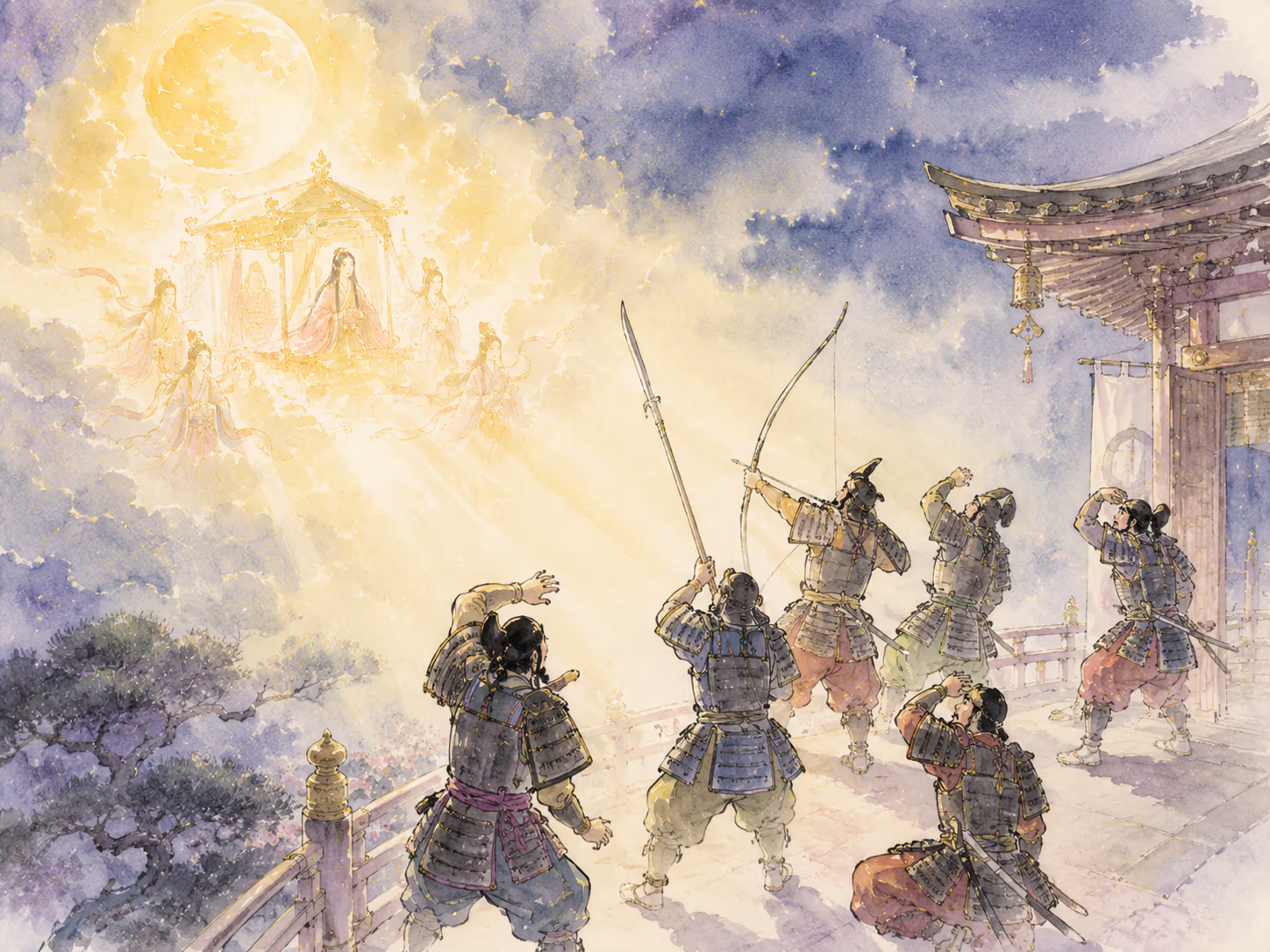
Guide to Princess Kaguya: the bamboo cutter, the Moon Princess, impossible tasks, the lunar procession, and the ache of…
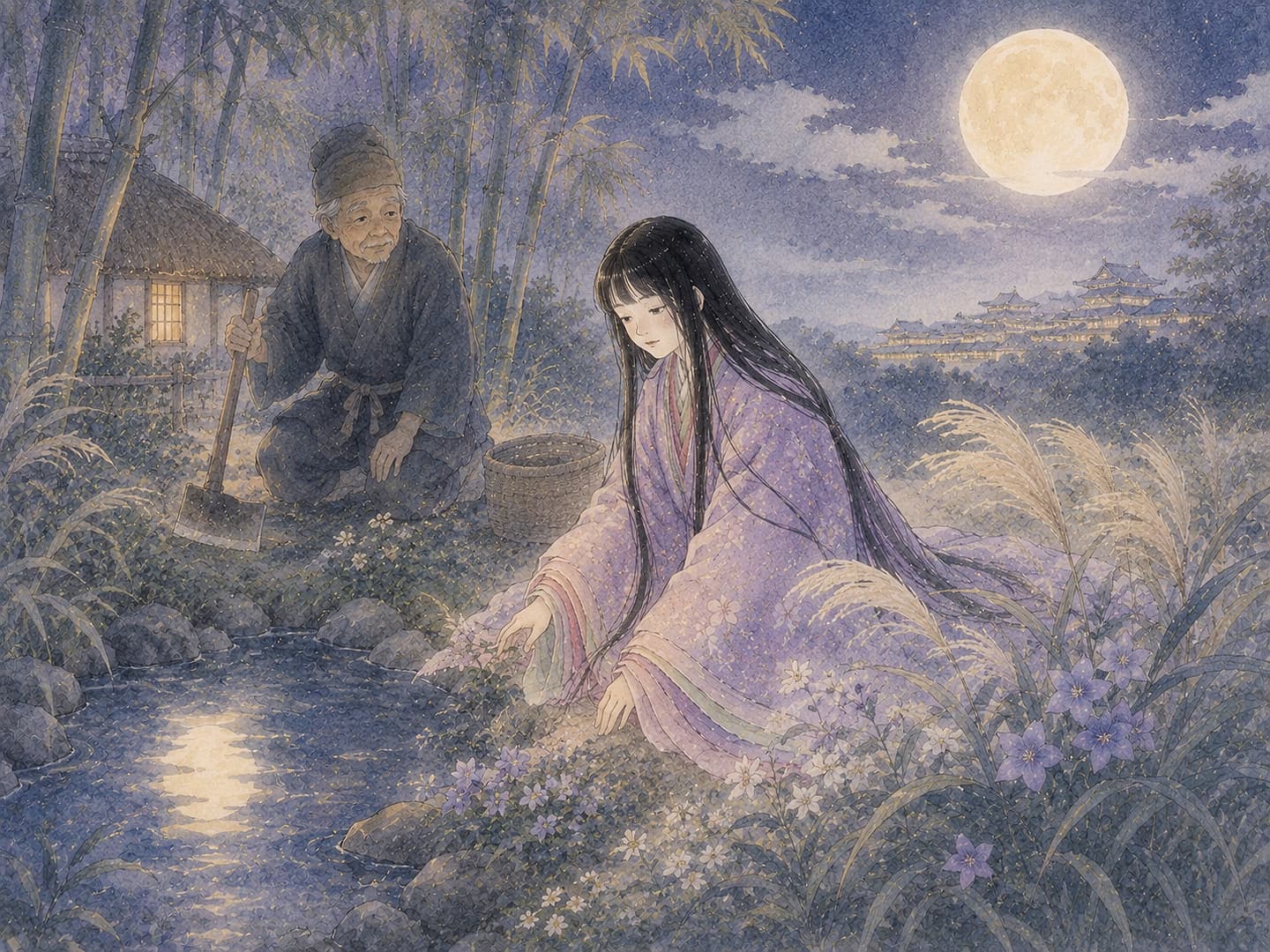
The classical work behind Princess Kaguya: monogatari, Heian court culture, humor, the Moon, and Kaguya-hime as literature.
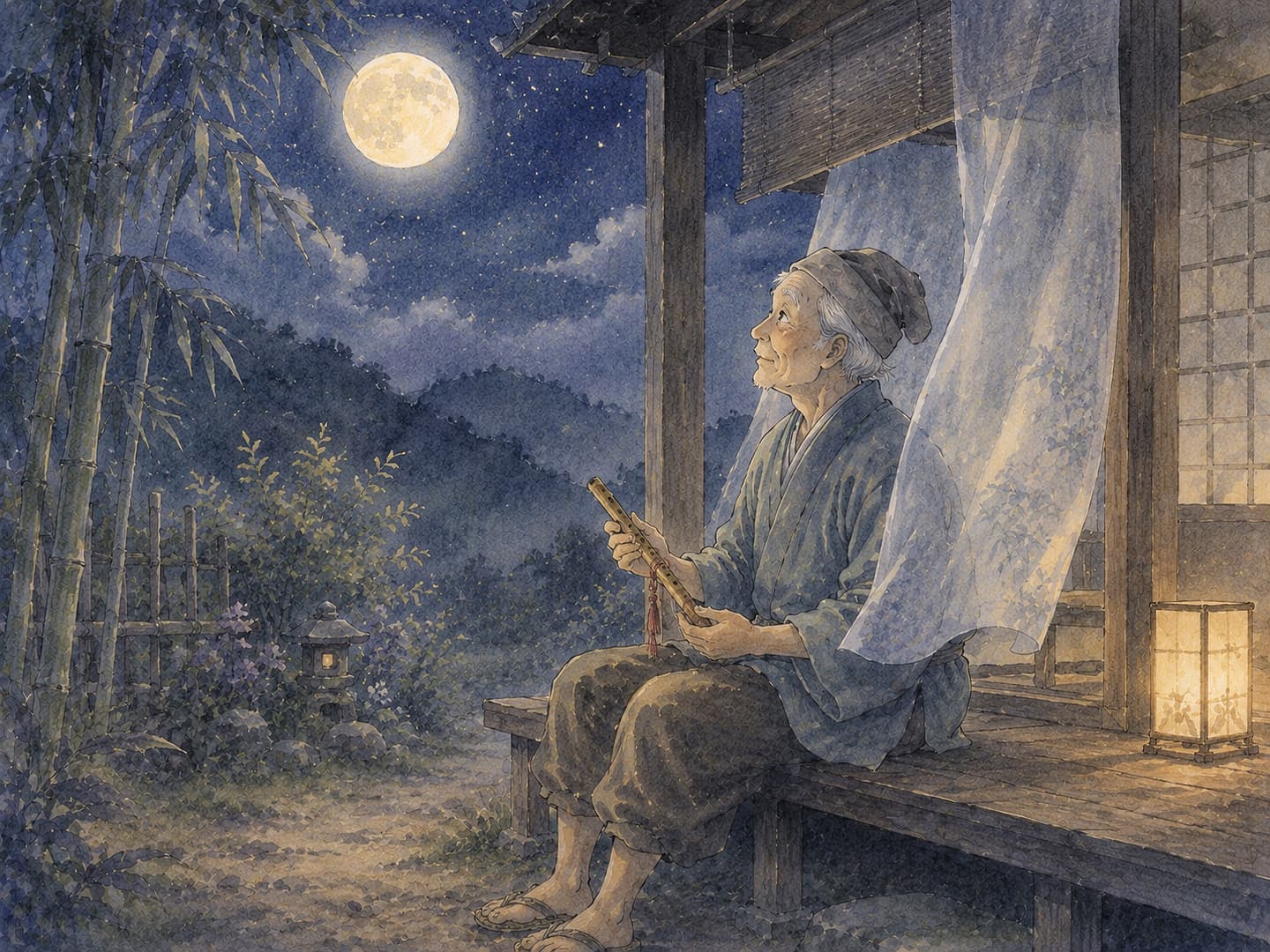
The old cutter as the human bridge of the tale: work, bamboo, adoption, household, wealth, and the limit before the Moon.
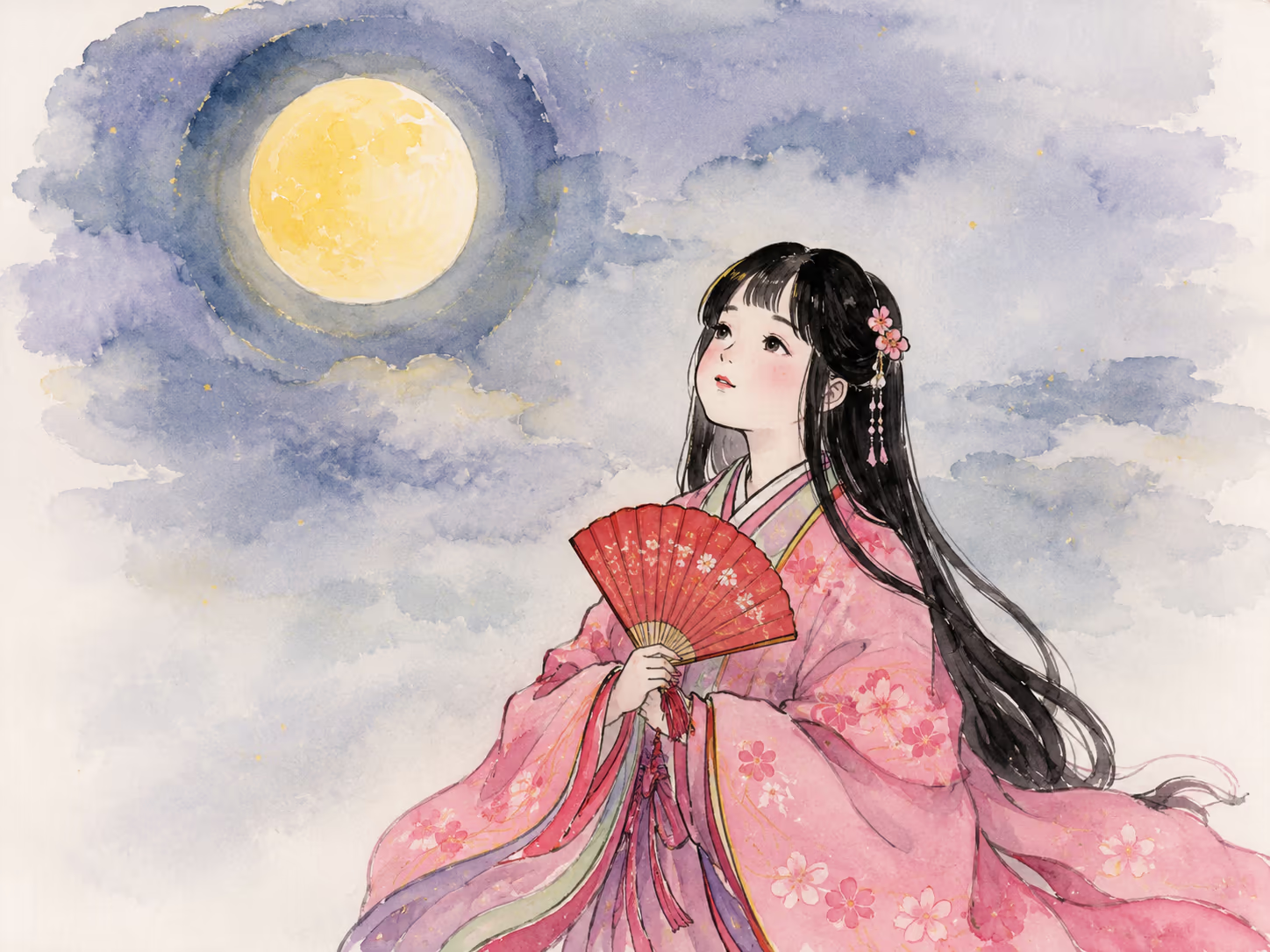
The Japanese tale of Kaguya-hime, the Moon Princess found inside bamboo and raised between affection, mystery, and fate.