Taketori Monogatari: The Tale of the Bamboo Cutter
Learn about Taketori Monogatari, The Tale of the Bamboo Cutter: a Japanese classic, the literary origin of Kaguya-hime, and a landmark of the monogatari genre.
What is Taketori Monogatari?
Taketori Monogatari, known in English as The Tale of the Bamboo Cutter, is the Japanese classical work that gave literary shape to the story of Kaguya-hime. Today many readers meet Kaguya through picture books, films, or illustrated retellings, but behind that image stands an old text tied to the birth of prose fiction in Japan.
The work is not only a summary of Princess Kaguya’s life. It combines wonder, courtship, humor, aristocratic names, desire, impossibility, and a farewell that still echoes through Japanese culture. That is why it deserves its own page: Taketori Monogatari is a literary work, a cultural matrix, and one of the great entry points into the monogatari genre.
The meaning of the title
The Japanese title 竹取物語 can be read quite directly: 竹 means bamboo, 取 suggests cutting, gathering, or taking, and 物語 means narrative, tale, or story. This is why the standard English title is The Tale of the Bamboo Cutter.
That title places the focus on the old cutter, not on the princess. This matters: the work begins with an encounter between an ordinary person and the impossible, a glowing bamboo stalk that opens human life to another world.
The tradition also preserves related names, such as Taketori no Okina no Monogatari, the tale of the old bamboo cutter, and Kaguya-hime no monogatari, the story of Princess Kaguya. These names show how the work moved between the title of the first encounter and the fame of the character who came to dominate popular memory.
What is a monogatari?
Monogatari does not simply mean legend. In literary terms, it points to prose narratives developed in the aristocratic environment of Heian Japan, where fiction, poetry, court etiquette, letters, humor, and marvelous elements could coexist.
This distinction separates two layers. Mukashi banashi refers to old tales transmitted as popular storytelling. Monogatari, by contrast, is a more literary form tied to writing, court culture, and prose composition.
Taketori Monogatari stands in precisely that fascinating space: it uses motifs that feel close to wonder tales, such as the child found in bamboo and the return to the Moon, but shapes them inside a courtly literary architecture.
When was the work written?
The exact date and author of Taketori Monogatari are unknown. The work is generally placed between the late ninth and early tenth centuries, in the Heian period, before the consolidation of later works such as The Tale of Genji.
That uncertainty does not weaken its importance. On the contrary, it reminds us that old literature often reaches us through layers of copying, circulation, commentary, and rewriting. The preserved text belongs to a living tradition, not to a simple bibliographic label.
So it is better to avoid absolute claims such as “it was written in this exact year by this person.” The more honest and elegant formulation is to say what can be said: it is an old, anonymous work, deeply tied to the Heian world and frequently treated as an early landmark of monogatari.
Why is it called an ancestor of monogatari?
In the Japanese classical world, Taketori Monogatari was already remembered as a founding work. In The Tale of Genji, it appears as a kind of ancestor of tales, a sign that ancient readers saw the text not merely as curious, but as a point of origin.
This does not mean that Taketori single-handedly invented all Japanese fiction. Literature has many beginnings. But the work holds a powerful symbolic place because it shows prose narrative already aware of its effects: scene construction, irony, suspense, courtly characters, and an ending that binds myth, emotion, and geography.
Reading Taketori in this way changes the question. Instead of asking only “what is the moral of Princess Kaguya?”, we can ask how such an old work transformed folktale-like motifs into literature.
Between folklore and the Heian court
The strength of Taketori Monogatari lies in mixture. The girl found inside bamboo belongs to the realm of wonder; the noble suitors, letters, poems, and courtly etiquette belong to aristocratic culture; the Moon, celestial beings, and medicine of immortality draw the text toward religious and continental imaginaries.
The work does not choose a single key. It is at once an origin tale, a court narrative, a fiction with humor, and a story of farewell. This hybrid quality explains why the text crossed so many centuries without becoming only an old document.
The Kaguya we know today is born from this layering: a luminous child, an unreachable young woman, a literary character, and a cultural image retold in very different forms.
The suitors and the humor of the work
One of the most important parts of the text is the arc of the five suitors. They are not just romantic figures waiting for an answer. They occupy a large portion of the narrative and reveal Taketori Monogatari’s most ironic side.
Kaguya sets impossible tasks, and prestigious men answer with bravado, fraud, or self-deception. The work watches that vanity with humor: faced with something they cannot possess, powerful men become small, ridiculous, exposed.
This prevents a simplistic reading of the story as a sad romance. Taketori Monogatari is also a delicate, sometimes funny critique of court society and the idea that beauty, status, or masculine desire could solve everything.
The Moon, immortality, and continental imagination
The work speaks with continental motifs known in Heian Japan: celestial beings, distant realms, elixirs, immortality, and worlds that do not follow the ordinary rules of human life. Such elements appear in Sino-Japanese traditions and in imaginaries connected with Daoism and the search for long life.
But reducing Taketori Monogatari to a “Chinese copy” would flatten it. The text transforms those motifs into a distinctly Japanese narrative centered on adoptive family, court life, desire, separation, and return to the lunar world.
The medicine of immortality at the end is especially powerful. It does not offer simple consolation. When human beings cannot keep what they love, even the promise of living forever loses meaning.
From Taketori Monogatari to Kaguya-hime
Over time, the character Kaguya-hime became more famous than the literary title. In many modern versions, readers first meet the Moon Princess and only later discover the name Taketori Monogatari.
That is natural. Kaguya concentrates the most memorable image of the work: beauty that shines, autonomy before suitors, sadness before departure, and an origin that never fully belongs to Earth. Still, remembering the classical title gives the character back her depth.
The Princess Kaguya of illustrated retellings is the popular face of a work that thinks about literature, court culture, humor, and impossibility with surprising sophistication for its age.
Why does Taketori Monogatari still matter?
Taketori Monogatari remains alive because it does not depend on a single reading. It can be read as a wonder tale, a classical text, a satire of suitors, a fiction about desire and impossibility, or a meditation on loss.
Its modern reception confirms that flexibility. The story appears in children’s books, painting, theater, cinema, anime, cultural projects, and even references to lunar exploration. Each era finds a different Kaguya, but almost always returns to the same signs: bamboo, Moon, light, absence.
In the end, the work matters precisely because of that. Taketori Monogatari stopped being only an old text and became a matrix of imagination: a way of asking what happens when something beautiful enters the human world, transforms everything, and then must leave.
Index of Japanese terms
Taketori Monogatari
The title of the Japanese classical work that gave literary form to the story of Kaguya-hime. It is usually translated as The Tale of the Bamboo Cutter.
Taketori no Okina
The old bamboo cutter. He gives the title to one traditional way of identifying the work and is the person who discovers Kaguya in the glowing bamboo.
Monogatari
A literary prose narrative form, especially associated with the development of Heian-period court literature.
Kaguya-hime
The Moon Princess who became the popular face of the work. Here she appears as a literary character, not only as a children’s tale figure.
Genji Monogatari
The Tale of Genji. Classical tradition remembers Taketori as an ancestor of monogatari within this literary world.
Fushi no kusuri
The medicine of immortality. At the end of the work, it connects Kaguya’s farewell to the Moon, Mount Fuji, and the human wish to defeat time.
Read also
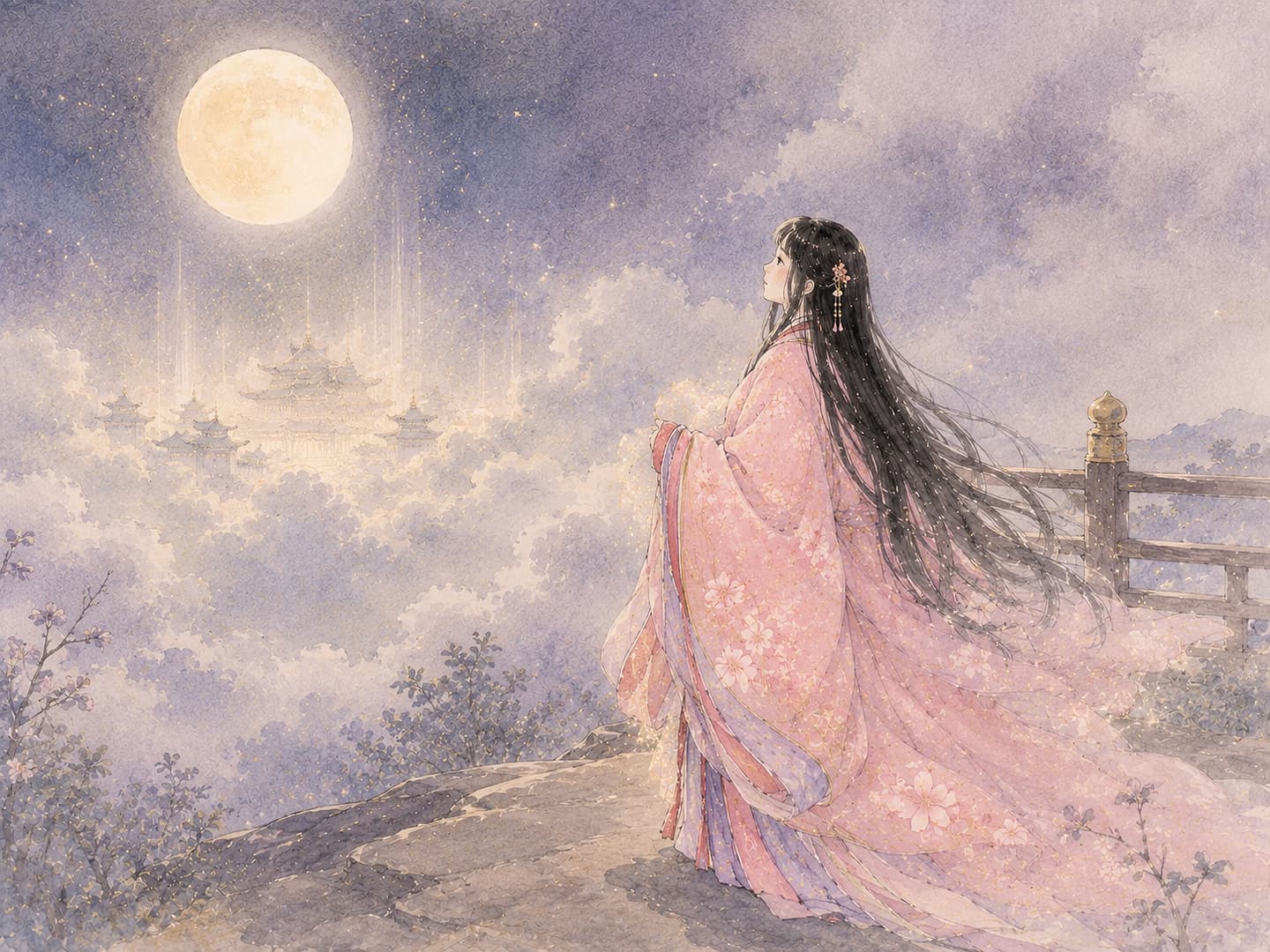
The cultural figure of Princess Kaguya: name, radiance, Moon, otherness, autonomy, and her lasting place in Japanese…
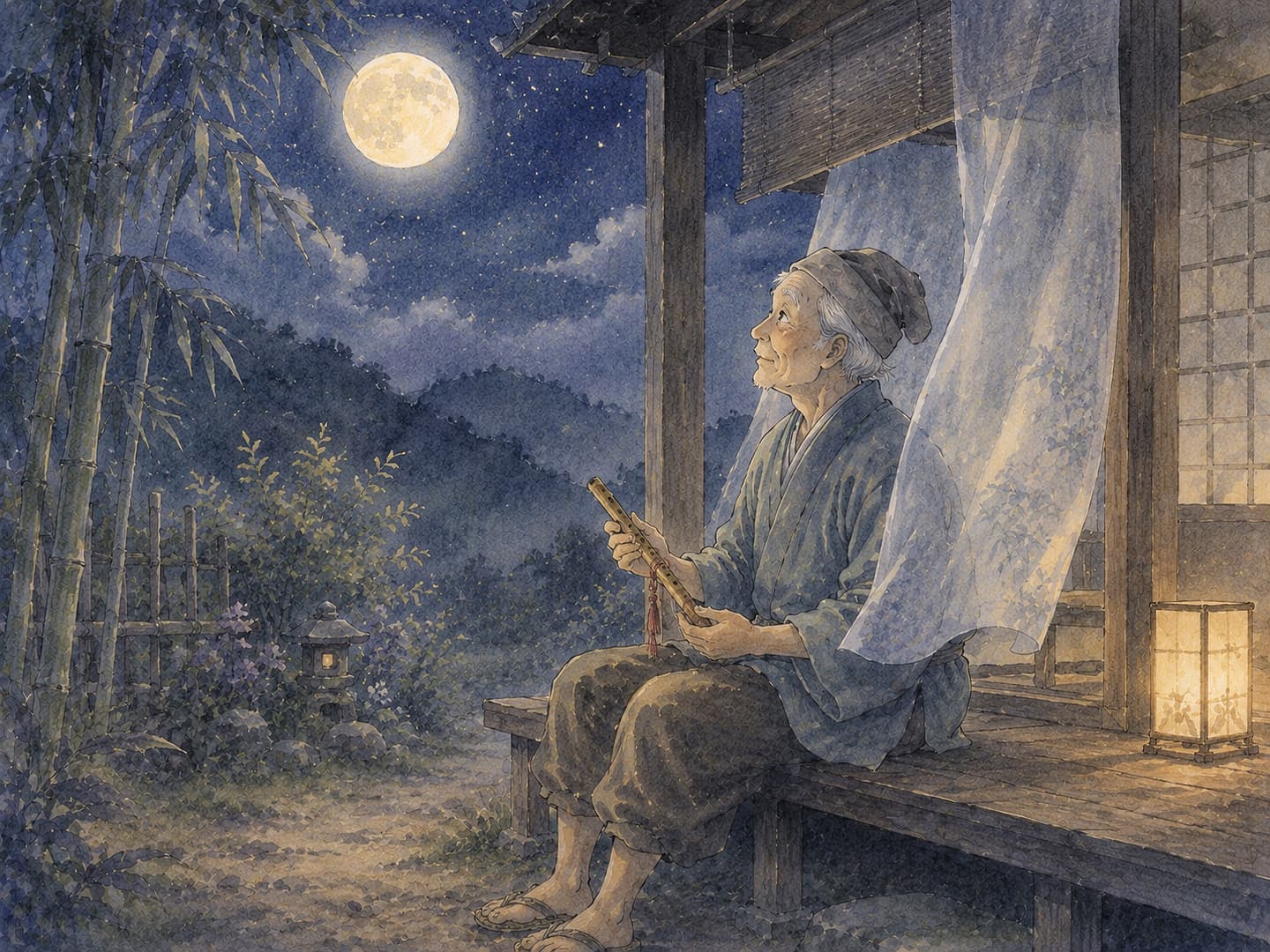
The old cutter as the human bridge of the tale: work, bamboo, adoption, household, wealth, and the limit before the Moon.
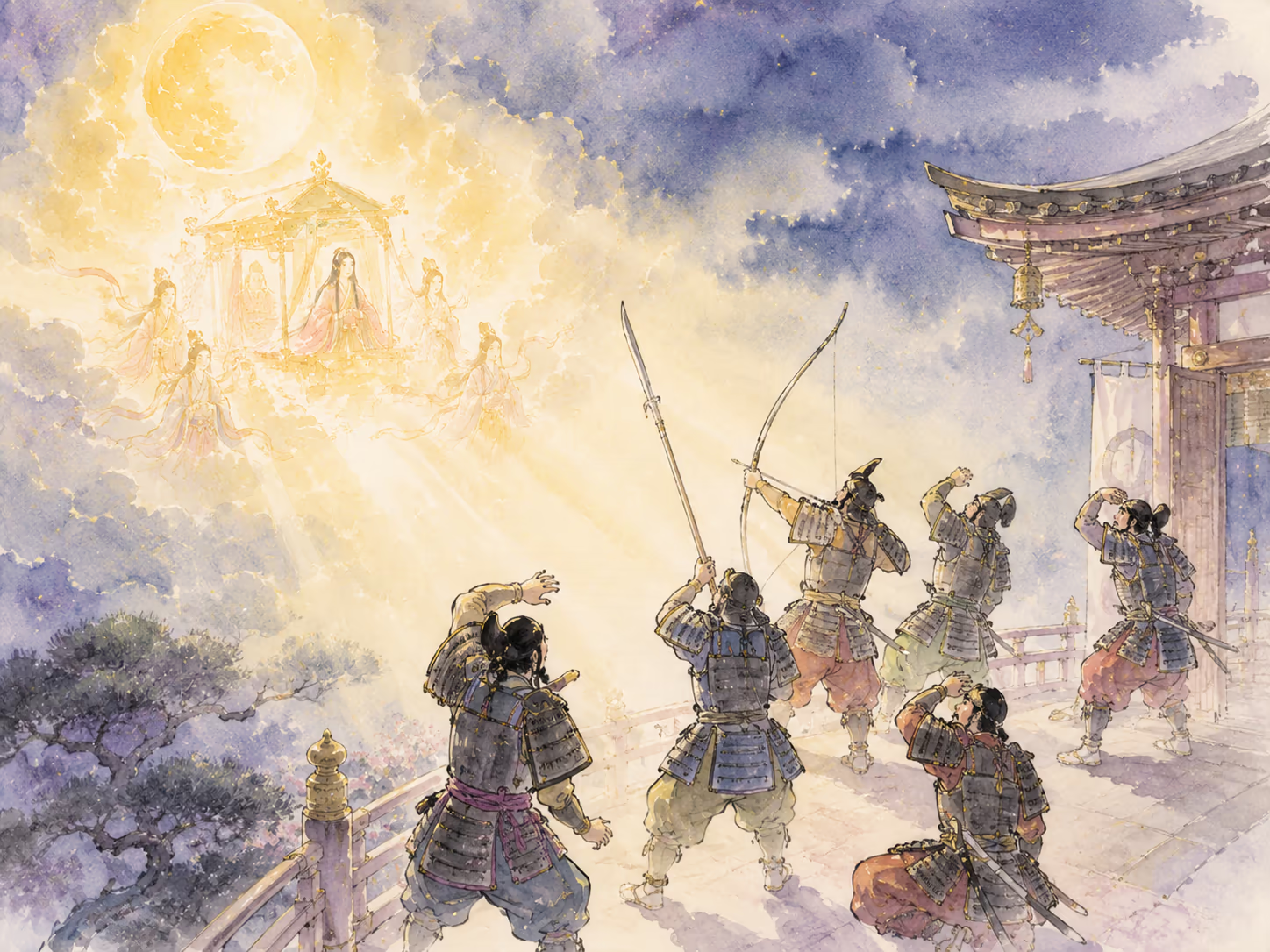
Guide to Princess Kaguya: the bamboo cutter, the Moon Princess, impossible tasks, the lunar procession, and the ache of…
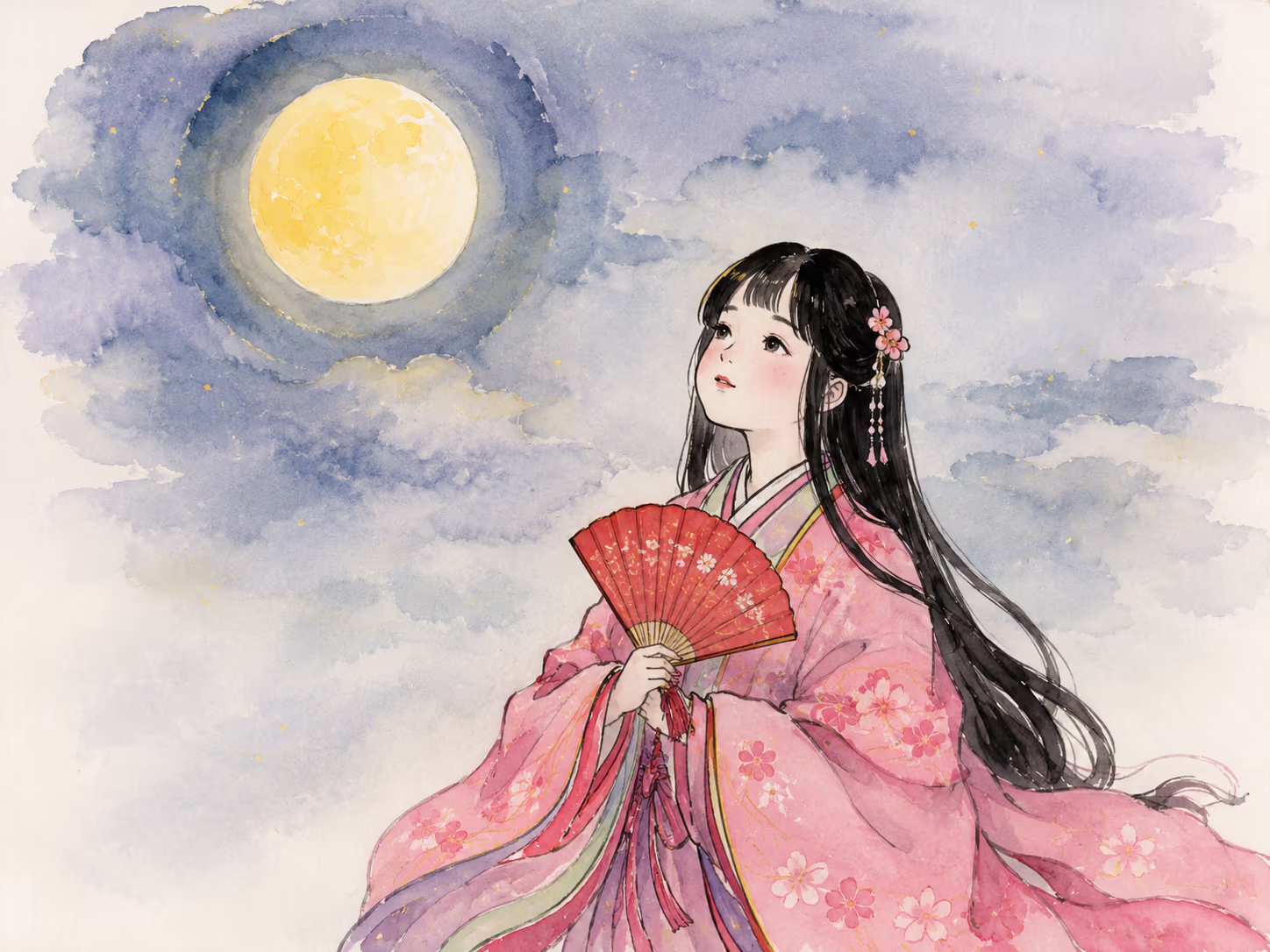
The Japanese tale of Kaguya-hime, the Moon Princess found inside bamboo and raised between affection, mystery, and fate.